
Doing Something For The climate isn’t just about lifestyle Choices, There are financial Options too7/15/2025
Thank you to Zach M., one of our summer interns, for this article
A changing climate isn’t just about lifestyle, it’s about our financial choices, too. Many people care deeply about the environment, but haven’t yet considered their retirement savings, investments, or bank accounts may be supporting industries that pose the greatest threats to our environment. Sustainable Wellesley encourages residents to expand their climate action in a powerful way: green investment. Climate-friendly investment means choosing funds, stocks, or financial services that will help you invest reliably to support environmental sustainability. What is climate-friendly Investment:
The global financial system plays a huge role in accelerating or slowing climate change; by investing your money in companies that are part of the solution, you choose to impact, not just profit. How to Get Started
Thank you to Michael M. for sharing his story!
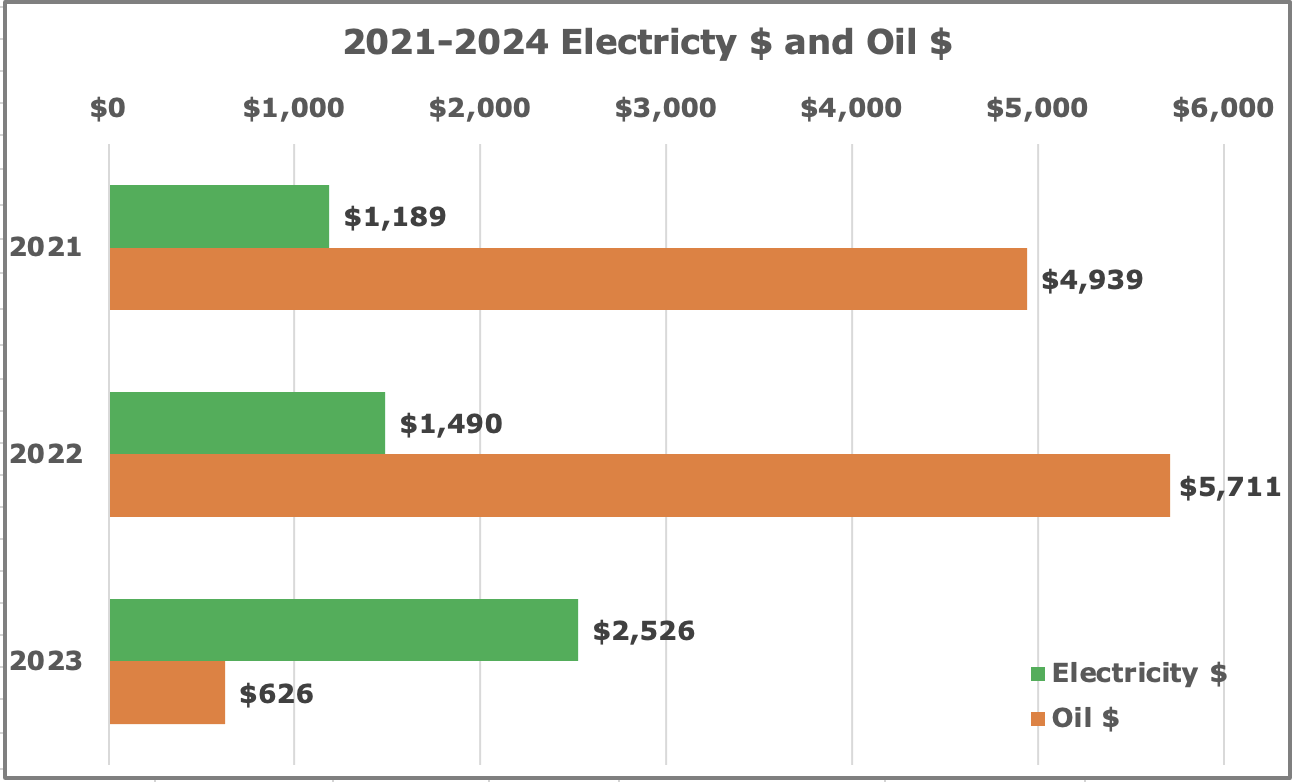
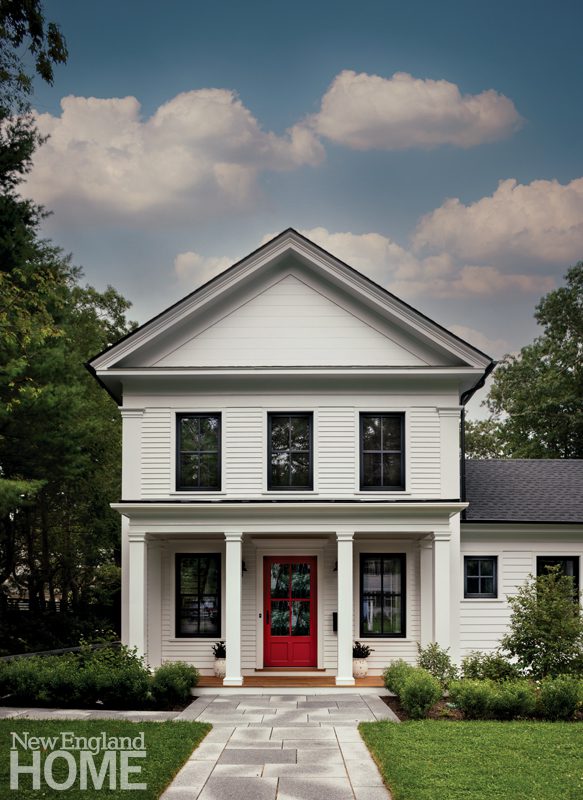
Now that we have had our heat pumps running for 2.5 years, I thought I would share an update for those considering switching to air-source heat pumps in their homes. Here is the initial article I wrote in April 2024 which has more background info. This is a good time to consider it as the Town of Wellesley and the State of MA offer incredible rebates and incentives for things like energy audits, insulation, heat pumps, and EVs — often more than the federal government. I have been tracking our electrical, water, and sewer costs for over 5 years. Having this data enabled me to verify that the investment we made to switch to heat pumps made financial sense. Above you will see two graphs that I hope you will find to be of interest. The first graph shows our Electric costs (Green) and our Oil costs (Orange) from 2021 through 2024. If you compare the total costs of 2022 (electricity + oil) your will get a total of $7,201 ($1,490 in electricity plus $5,711 in oil costs) for the year. If you then look at the cost of only electricity in 2024 (since our oil furnace was removed) you get a total cost of $2,606. The ratio of these two costs is $2,606 / $7,201 you get a ratio of 36%. That means that our 2024 costs were $36% of our 2022 costs, or the 2024 costs were 64% less than the costs in 2022. The second graph shows the same story but using our costs per square foot. You’ll notice in 2022 the cost per square foot for oil + electric was $4.06 ($0.84+$3.22) and the cost in 2024 for all electric was $1.47. That cost ratio is also 36%. Overall, we have had a great outcome from switching to air-source heat pumps. This experience has compelled me to become an “energy coach” in Wellesley to assist other residents considering making a switch from oil or gas to an all-electric solution. One final note, the cost of electricity in Wellesley is ~$0.16/kWh largely due to the presence of our Municipal Light Plant (MLP). Other towns in Massachusetts without an MLP have costs of $0.32/kWh and higher. With the high temperatures expected tomorrow (Wednesday, July 16th), the Town of Wellesley would appreciate your help in reducing our system peak usage by minimizing the use of your air conditioner(s) and turning off EV chargers and other appliances (clothes dryers, dehumidifiers, pool filters), especially between the hours of 4 pm and 7 pm. Turning up your thermostat by just a few degrees will go a long way towards reducing our energy costs and greenhouse gas emissions.
Thank you for your support! Shave the Peak! Outdoor watering restrictions for Wellesley are no longer in effect as of June 17, 2025.
The Wellesley Board of Public Works (BPW) rescinded the one-day per week watering rules since our area is no longer experiencing Level 1 drought status. During the coming summer months, the state Drought Task Force will continue to review conditions, and the drought status might change especially as temperatures rise. If this happens, notifications will be sent out via the Town of Wellesley website and social media posts. For information about Massachusetts drought conditions, visit the State drought status webpages. Water Conservation Encouraged As part of Wellesley's ongoing water conservation efforts, the DPW Water Division recommends that homeowners continue prudent watering and lawn irrigation. Watering deeply and less frequently helps promote healthy root growth for a more drought tolerant lawn. The Natural Resources Commission offers tips for healthy and sustainable lawn and landscape care. Questions? Contact the Water Division at [email protected] or call 781-235-7600 x3355. The Town of Wellesley is encouraging residents to try something new.
Explore ways to get around via public transit or bike or walk and you can enter to be part of a $200 raffle. TRY THESE 4 TRANSPORTATION MODES: • . Ride MWRTA Route 1 Bus • . Ride MWRTA Catch Connect • Ride MBTA Commuter Rail • Walk or Bike (where allowed) Wellesley's Trails Ride all 4 and you will be entered in to win the $200 cash grand prize raffle! Log at least 2 trips to be entered into the raffle. Be sure to to take pictures while traveling and log your trips and upload photos in order to win. You can record each trip as you go, or add them all at once. The challenge runs May 1- June 30th. Don't forget... "YOU ARE NOT IN TRAFFIC...YOU ARE TRAFFIC" Are you interested in a safe, affordable and resilient energy system that meets our future needs? Geothermal is just that.
Want to know more? Watch this video to learn about efforts in Newton to explore this exciting clean energy opportunity. Wellesley is also looking into networked geothermal so we though we would share what our neighbors are up to as a starting point. In Newton the innovative, fossil fuel–free geothermal system is being installed at an elementary school and hopefully expanded to nearby homes—and eventually to neighborhoods across Newton. Framingham is already embarking on this, as are many other communities. In the video, you’ll discover:
Ready to take the next step? After watching the video, please reach out if you have interest and background at [email protected]. Thank you to Green Newton for sharing this! As we head into the summer season, Tenacre School sixth graders in collaboration with their tech, science, and the Parents Association have designed signs for the parking lot and driveway, encouraging an open-your-window approach to staying cool this summer.
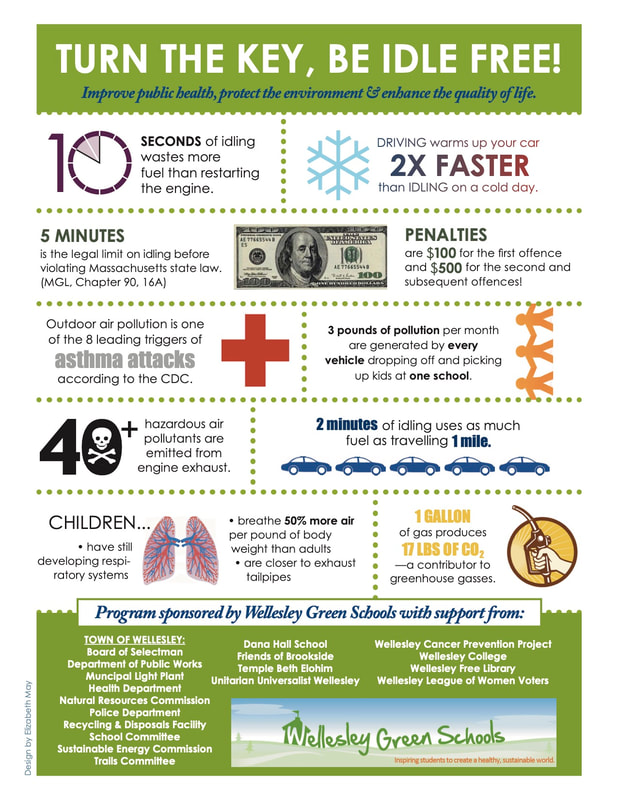
The sixth-graders dove deep into the art of persuasion, studying propaganda posters from 1900 to today to understand how design influences behavior. They discovered multiple compelling reasons to turn off engines: idling increases CO₂ emissions, wastes fuel and money, creates unnecessary noise for the school community, and puts unnecessary wear on vehicles not designed for prolonged idling. Monitoring air at schools has shown increased levels of formaldehyde, benzene, and other toxins during the pick-up hour. For children’s developing lungs, this increases the risk of respiratory problems and other long-term adverse health effects. Plus, it's a Wellesley town ordinance! With parents as their target audience, students crafted messages that balance environmental responsibility with practical health and economic benefits. Their colorful, thoughtful designs remind us how a simple turn of the key can make a big difference for our planet, our bodies, and our pocketbooks. Let’s take our cues from the sixth-graders and be an idle-free community! Gardens often carry the reputation of being difficult to manage. However, after visiting two very different but equally inspiring homes, each with their own unique approach to gardening, I learned firsthand about the beauty and benefits of cultivating your own garden.
The first home I visited was Lisa’s, where she was creating a native garden. A native garden is a landscape designed with plants found in local regions. Native gardens are known for their ecological benefits such as using less water, supporting biodiversity, and attracting native wildlife. I arrived while the garden was still being installed, so I had access to the garden plans and observed the layout. Her garden was filled with various plants, every plant supporting a purpose, either medicinal or edible. What stood out most was Lisa’s focus on pollinators. These were thoughtfully planted to support endangered native bees as these plants play crucial roles in the lifecycle of specific species of endangered native bees. One particularly fascinating feature was her herbal spiral: a raised spiral structure that creates a variety of microclimates to support different herbs. She also showed me her butterfly garden, which was a beautiful alternative to an otherwise unused piece or her yard. Lisa described her garden as low-maintenance thanks to a well-designed irrigation system and the hardworking bees. The second garden I visited was Pam and Paul’s. They have an organic garden, embracing what was already growing on their land. Their hands-on, sustainable approach with no mowing, no leaf blowing, and minimal outsourcing created a lush, dense, thoughtful garden. One of the most important parts of their garden was the soil. Pam and Paul emphasized that if you want a happy garden you must have healthy soil. They compost everything in several bins, carefully turning the soil and sifting out large pieces of wood. They also collect rainwater in large barrels, which they use to water the entire garden. As we walked through the property, they shared stories about nearly every plant: which animals visited it during different seasons, how tall it grew, how often it had been relocated, and how they kept it healthy. One of the most memorable stories they shared was about their trees. When some trees began to die, instead of removing them entirely, they trimmed them down to just a few branches. Over time, the trees came back to life larger, stronger, and healthier than before. While Pam and Paul’s garden required more maintenance, it had surely paid off in creating a beautiful, sustainable, environmentally conscious garden. These two gardens were vastly different in appearance and upkeep, yet both demonstrated how gardening can be sustainable, meaningful, and rewarding. Lisa’s native garden showed that a low-maintenance, eco-friendly space can support pollinators and serve practical uses. Pam and Paul’s organic garden illustrated how time, care, and trust in nature can create a deeply personal, thriving ecosystem. What I took away from both visits is that gardens don’t have to be perfect or high-maintenance to be meaningful. Want some tips and tricks on growing foods and plants in your garden? Watch the video from our collaborative garden event here. Ayesha K, a WHS student, in partnership with the Wellesley Recycling and Disposal Facility (RDF), created an innovative new app called ReCirc.
Think of ReCirc as a “free eBay” for our recycling center — an easy-to-use platform where residents can post photos and descriptions of items they’re dropping off in the Reusables Area and browse what others have listed, all in real time. Whether it’s a lamp, bookshelf, or kitchenware, ReCirc helps give pre-loved items a second life and keeps reusable goods out of the landfill. ReCirc is free to download on the Apple App Store. The next time you visit the RDF, take a moment to snap a photo and post your item—you might just find it a new home. If you are looking for something, you can browse through the cataloged items on the app, look through specific categories, and search for certain items they are looking for. By viewing whether the item is available, they can then go to the recycling facility to pick it up. To learn more or get started, visit www.recirc.co. Recirc’s goal is to lessen waste created by unused items, and find homes for more items. They are looking for volunteers to help initially log in the items and spreading word about the app. Anyone who is interested in volunteering can reach out to us and we will connect you to the Ayesha. Trying to reduce plastic in your life? Give this a try...
Most beauty products are in plastic, expensive and run out quickly, at least that’s been my experience. So when I first heard about buying in bulk, I was skeptical. I assumed it would cost more and the products wouldn’t work as well. However, I was quickly proved wrong. Buying in bulk was completely new to me. I walked into Fulfilled Goods in Newton with clean, empty bottles and absolutely no idea what to do. Thankfully, the staff noticed I looked lost and kindly guided me to the weigh station, where I tagged and weighed my containers. The process was quick and simple, and I caught on fast. Though the store was small, it had a wide selection of beauty, cleaning, and dry goods. I stuck to products that fit into my usual routine: shampoo, conditioner, face wash, body wash, and granola. The granola was purchased because I panicked and did not know what to put in my last container. I also picked out a conditioner bar and a baking soda deodorant. Since I wasn’t sure what I’d like, I only filled the containers halfway. To my surprise, everything came out to less than $50, cheaper than my regular shampoo and conditioner, which alone usually cost around $30. The re-use option and low price tag were already pros for me, however the products had to perform well. That night I tried the shampoo and conditioner. I would like to note that I hadn’t tested the scents beforehand, and afterward, my friend commented that I smelled “earthy and masculine.” Although I didn't smell bad, it was definitely stronger than expected. There were many other scent options, I simply failed to test them. Thankfully, I had picked a more pleasant scent for the body wash, and I used the conditioner bar as a leave-in. The results? My hair has never looked or felt better. For context, I have slightly damaged 2c/3a curly hair so I am very particular on what I use on my hair. My hair was clean, smooth and super defined. I even went outside into the pouring rain and my curls held up. For the other products: the face wash was effective, and helped prevent breakouts after a week of use, however, it was the priciest at about $4 per ounce. The deodorant, while it smells nice, did not prevent sweating so it may not work for everyone. Finally the granola, no notes, it was amazing, I wish I bought the entire jar. In short, I’m fully converted to buying in bulk. It's affordable, effective, and more sustainable. Fulfilled in Newton Goods made the process easy, and I highly recommend visiting if you're nearby. If not, other stores like Boston General Store in Dedham and Brookline offer similar options. While I recommend shopping small and shopping local, if you are in a pinch most big name retailers sell shampoo and conditioner bars, though I can't vouch for their quality. Thanks to all who donated their un/underused items -- keeping them out of landfills and putting them to good use of local families facing hardship. A special thanks to Wellesley High School seniors for collecting and delivering these items to Welcome Home, a local home goods pantry.
If you would like to donate any gently used home goods in good working condition (no stains, tears or chips and all appliances should be in working condition) and provide families with items they need to live with dignity, please go sign up for a time slot to drop off your items. This local nonprofit collects and redistributes like-new household items to hundreds of people in need each month with no fees, no forms and no requirements. Any items that they cannot use are repurposed or recycled appropriately, thus benefiting the environment. Please look around your home and They are especially in need of
Thanks again to our Wellesley High School SENIORS. Please join us at the Climate Café on Thursday, June 12 from 4 to 7 PM at the Wellesley Free Library.
Wellesley High School and Wellesley Public School Community,
Please help support Wellesley High School Seniors on their upcoming community service day. This great senior tradition will happen on Wednesday, May 28. Wellesley High School seniors will collect and deliver pre-loved home items to Welcome Home in Newton. Since 2016, this volunteer staffed organization accepts home goods from anyone wishing to donate and keep items out of landfills. These goods are cleaned, shelved, and made available to people struggling to meet their basic needs. Women make up the majority of the requests they receive, most of whom care for children, parents, spouses, siblings and neighbors. The goods one client receives therefore serve to benefit many, bolstering health, self- esteem and a sense of well-being. It is their vision to see that everyone who contacts Welcome Home receives the essential kitchen, bath, bedding, and decorative items they need to turn any living situation into a home. Please look around your home and donate any gently used home goods in good working condition (no stains, tears or chips and all appliances should be in working condition). They are especially in need of
Please review the available slots here and click the button to sign up. On Wednesday, please leave any goods on your doorstep or visible location on your property labeled "Welcome Home". Thank you! - Wellesley High School SENIORS Volunteers are an integral part of Wellesley Town Government.
The Select Board is actively seeking candidates to appoint to Town boards, committees, and commissions. These individuals will fill vacant positions or replace members whose terms are expiring. Appointments are made annually in the late spring for terms beginning on July 1. The Select Board follows its Appointments Policy to select individuals who would like to serve on the following boards/committees for the coming Fiscal Year (July 1, 2025 - June 30, 2026):
*Please note: If you will be reappointed to a board or committee on which you already serve, you will STILL need to complete the Volunteer Form. To learn more about specific boards or committees, or to inquire about boards or committees not appointed by the Select Board, please visit the Town Government pages and search alphabetically. Speaker: Kelly Beatty; Officer, MA Chapter of Dark Sky
Wednesday, May 14, 7:00pm Wellesley Free Library, Wakelin Room Come learn how you can safely light up your home, business, and community without wasting energy, disturbing your neighbors, or creating an unhealthy environment for humans and wildlife. Light pollution, simply put, is any unnecessary or excessive outdoor illumination. It robs us of the night sky’s beauty, negatively affects the ecosystem, and creates an in-your-face waste of energy. But a new mindset and new technology are poised to slow this bane of modern life. Kelly Beatty has been explaining the science and wonder of astronomy to the public since 1974, when he joined the staff of Sky & Telescope. He served for more than a decade on the Board of Directors for the International Dark-sky Association (darksky.org) and is now an officer with DarkSky’s Massachusetts chapter. Sponsored by: Wellesley Conservation Land Trust Spring Lecture Series Co-sponsored by: Sustainable Wellesley and Wellesley Free Library. Thursday, May 15th @ 12PM
Massachusetts has a rebate for new and used electric cars and trucks (EVs) called MOR-EV. During this webinar, they will go over the rebate and how much it can save you on an EV. REGISTER HERE They’ll talk about:
“There are a lot of issues that affect young children, but you can actually tie all of those issues back to climate,” said Pediatrician and Chief Science Officer at the Center on the Developing Child at Harvard University Dr. Lindsey Burghardt last week in Wellesley.
Dr. Burghardt discussed how children’s development is deeply influenced by environmental factors and emphasized the importance of addressing systemic issues like pollution, violence, and climate change, which shape early childhood outcomes and long-term health. A warming climate connects to nearly every major issue affecting children’s well-being, making it a central concern for future health and equity. Many of you asked for a recording, so here it is. To learn more about the work Dr. Burghardt and the Center on the Developing Child at Harvard University does, click here. For ideas on things YOU CAN DO - big and small - click here. Bring your family, neighbors and friends to walk with us in the Wellesley Parade Sunday, May 18th from 1-3pm.
RSVP here. Enjoy the shout outs and cheers from friendly spectators along the route. You can feel the environmental enthusiasm in town. We will be encouraging actions that will help us meet the Town-wide goal of reducing greenhouse gas emissions by 2050. Help us get the word out on fighting pollution. We will be lining up at 12.45pm near the corner of Woodlawn and Washington Streets (Pole #3). Should be fun. Strollers welcome. Rain date June 1st. RSVP here. In case you are looking for another hands on volunteer opportunity that day... Our community needs extra hands to help out the waste sorting project during the Picnic/Carnival/Fireworks event on Sunday, May 18th on Hunnewell Field. There are many time slots (3:30pm-10 pm) to fit your schedule so sign up here for one today. Wellesley's work to improve the climate has earned state recognition. At a ceremony with state officials on Friday, May 2, the Town was recognized by the Healey Driscoll administration as one of the first communities in Massachusetts to earn the Climate Leader certification.
With this certification, Wellesley will be eligible to apply for over $1 million in grant funding to support implementation of the Climate Action Plan and progress toward the Town’s goal of net zero greenhouse gas emissions by 2050. The Climate Leader program is offered by the Department of Energy Resources (DOER) and seeks to reduce greenhouse gas emissions and maximize the efficiency of buildings and transportation. Grant eligible projects include those involving renewable energy, battery storage, building electrification, and energy efficiency. Wellesley joins 18 other Massachusetts communities receiving this designation. Sustainability Director Marybeth Martello led a cross-department effort to obtain certification, with significant contributions from Sustainability Analyst Janet Mosley; valuable input from the Facilities Management Department, Department of Public Works, and Municipal Light Plant; and critical support from the Select Board and School Committee. Climate Leader status reflects the following achievements in climate action, including:
Wellesley became a Green Community in 2017 and since then, earned nearly $1 million in grant funding to support projects such as the Warren Building renovation, multiple LED lighting retrofit projects, and hybrid police cruisers. Pictured above are: Lt. Governor Kim Driscoll, Sustainability Director Marybeth Martello, Sustainability Analyst Janet Mosley, and DOER Commissioner Elizabeth Mahony. 15 Things you can learn about at the Sustainable Street Tour on May 17
Join Green Newton at our Sustainable Street Tour on Saturday, May 17, 2-4 pm. Talk to four Newton neighbors, as well as Newton Energy Coaches about sustainable projects. BTW, Wellesley has no cost energy coaches too so contact them for more local approach. There’s nothing better than speaking directly with someone who has completed a project to help you get started on yours. They will be on Fair Oaks Avenue in Newtonville, between Fessenden and California Streets, showcasing these 15 sustainable features (and probably a lot more), all within a 2 minute walk:
Sign-up is optional, but recommended at https://greennewton.org/street-tour/ Have a student in the schools?
Join the Wellesley Green Schools last meeting of the school year on Thursday 5/15 @10am in the Hardy Innovation Room. Never been? No Problem? New voices and ideas welcome, especially as we think ahead to the next school year. Topics include: waste reduction, transportation, healthy buildings, anti idling initiatives, biking, student projects, school gardens and more! Email [email protected] with questions and ideas for the Wellesley Green Schools team. We love a re-use story.
The annual Bargain Haul at St. Andrew's Episcopal Church will be held Saturday, May 3rd from 8:00am – 12pm. Bag sale 11:15. 79 Denton Rd., corner of Washington St. (Rt 16) and Weston Road, Wellesley. The enormous selection includes jewelry, clothes, toys, housewares, books, electronics and more! Admission is $2. RAIN OR SHINE! Pediatrician and Chief Science Officer at the Center on the Developing Child at Harvard University Dr. Lindsey Burghardt discusses Climate, Kids and Health (Physical & Mental) with Wellesley parents/caregivers on Wednesday, April 30th at the Hunnewell School at 7pm. Confirm your seat here.
The recent fires in LA (even some in Milton last year) have extreme weather issues on parent's minds. Dr. Burghardt will cover the connection between allergies, asthma, brain development, heat, pregnancy, low birth weight and preterm birth as well as vector borne diseases with our warming climate. She and others will offer suggestions on ways to mitigate these issues. Individually and collectively, there are a variety of actions we can do to create a healthier future for our children. Make time for this important discussion. RSVP as there is limited seating. WHS Alum Kaitlin is looking for your input in her college research project on exploring climate activism.
Thank you for taking the time to participate in this quick survey! This survey is part of a research project exploring climate activism, with a focus on how factors like privilege, community wealth, and personal circumstances influence who is able to participate in and organize grassroots environmental movements. Your responses will help students better understand the social dynamics behind climate action around the world. Your answers are completely anonymous and will only be used for research purposes. There are no right or wrong answers—they're simply interested in your experiences and opinions. Thank you again for your time and input! |
Categories
All
|
RSS Feed